AML/CFT in Benin: compliant texts, failing men
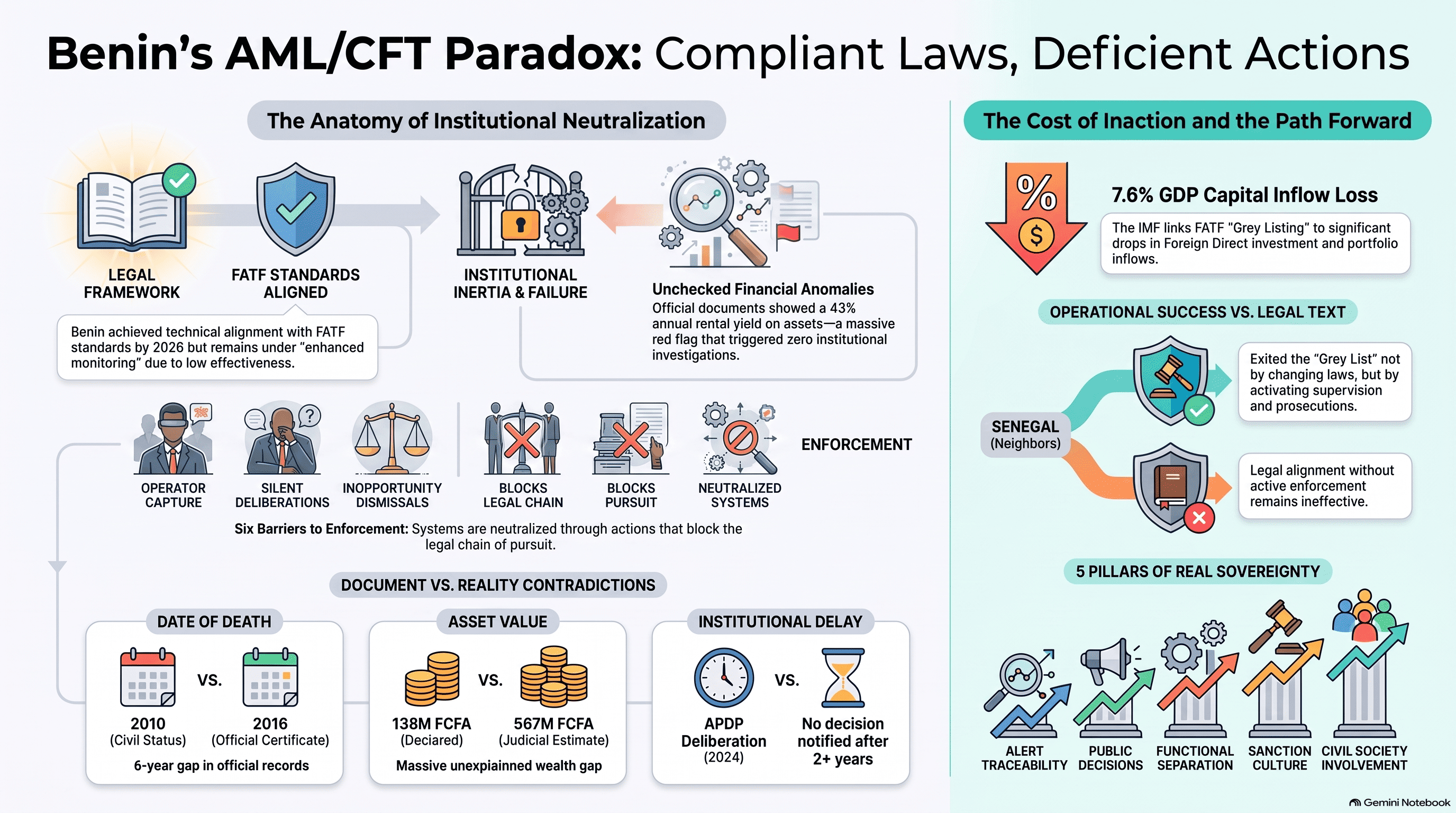
Standfirst. Since Law No. 2024-01 of 20 February 2024, Benin has had a framework for combating money laundering, terrorist financing and proliferation (AML/CFT/CPF) that is technically aligned with FATF standards. Recommendations R.16, R.24 and R.25 were reassessed favorably by GIABA in its 5th enhanced follow-up report (2026). Yet the same report confirms the continuation of the enhanced follow-up regime inherited from a mutual evaluation report (2021), which highlighted the weak effectiveness of the 11 immediate outcomes. How can a country whose texts are deemed compliant fail to apply its own system? The documented case presented here — an estate matter whose official documents contradict one another, brought before nine institutions between 2020 and 2026, to which an investigative unit must be added — is not the subject of this article: it is its proof. It reveals seven mechanisms through which men, and not texts, neutralize a control system.[1][2][3]
Thesis. The chain detection → reporting → analysis → dissemination → investigation → prosecution → deterrence is fully written into the law. It breaks down at every link, not because a rule is missing, but because of a failure of implementation: when a supervised operator becomes the source of information for the authority supposed to supervise him, when an alert can be disqualified without being examined, when an announced deliberation is never notified, when a dismissal closes a file without a hearing, when the supervision of a reporting profession cannot even retrieve the file. Compliance is not proclaimed; it is administered. That is where financial sovereignty is decided.
1. The case in three facts
- An authentic instrument — the certificate of acquisition of rights dated 20 October 2016 (case 732, folio 21) — records a death on 10 June 2016, whereas the civil-status death declaration places it on 6 December 2010: a gap of 5 years, 6 months and 4 days between two official documents.
- The same declaration records a value of 138,300,000 FCFA for the properties, whereas a letter from bank [A.] dated 5 October 2011 certifies 60,000,000 FCFA in annual rents.
- Plot “B” of lot 488 (Gbégamey), which judgment No. 114/14/3e CH-EP of 31 October 2014 states was bequeathed to the heir, is absent from the public registers: the municipal register records it in the name of a third party, and the National Geographic Institute states that it has no document relating to it, according to a compulsion report drawn up by Martin Jean D.C. GOUNADON, bailiff before the Court of Appeal and the First Class Court of First Instance of Cotonou, on 19 December 2017.
These contradictions are materially established by official and authentic instruments, without any documented institutional explanation having, to date, made it possible to resolve them.
Table of calculated material discrepancies
Reading method: the results below are either exact or rounded to one decimal place when the calculation produces a ratio or a percentage.
| Compared point | Source 1 | Source 2 | Calculation | Result | Qualification |
|---|---|---|---|---|---|
| Date of death | Death declaration: 06/12/2010 | Certificate of acquisition: 10/06/2016 | 10/06/2016 − 06/12/2010 | 5 years, 6 months and 4 days | Chronological gap between two official instruments |
| Asset value | Judgment No. 114/14/3e CH-EP: 567,990,000 FCFA | Certificate of acquisition: 138,300,000 FCFA | 567,990,000 − 138,300,000 | 429,690,000 FCFA | Absolute gap between the two amounts |
| Ratio between the amounts | Judgment: 567,990,000 FCFA | Certificate: 138,300,000 FCFA | 567,990,000 / 138,300,000 | ≈ 4.1 times | The judgment amount is about 4.1 times higher than that of the certificate |
| Share of the certificate within the judgment amount | Certificate: 138,300,000 FCFA | Judgment: 567,990,000 FCFA | 138,300,000 / 567,990,000 | ≈ 24.3% | The certificate retains about one quarter of the judgment amount |
| Apparent rental yield (under the assumption of the same asset perimeter) | Annual rents: 60,000,000 FCFA | Declared value: 138,300,000 FCFA | 60,000,000 / 138,300,000 | ≈ 43.4% per year | Apparent yield that is economically atypical if the two documents concern the same asset or set of assets |
| Implicit rent multiple (same assumption) | Declared value: 138,300,000 FCFA | Annual rents: 60,000,000 FCFA | 138,300,000 / 60,000,000 | ≈ 2.3 years of rent | Implicit valuation that is very low for a standard income-generating asset |
Matrix of documentary contradiction
| Question | Document A | Document B | Contradiction observed |
|---|---|---|---|
| Date of death | Death declaration (civil status): 6 December 2010 | Certificate of acquisition of rights (case 732, folio 21): 10 June 2016 | Gap of 5 years, 6 months and 4 days |
| Value of the estate | Judgment No. 114/14/3e CH-EP of 31/10/2014: 39 properties valued at 567,990,000 FCFA | Certificate of acquisition: total property value of 138,300,000 FCFA | Absolute gap of 429,690,000 FCFA, i.e. a ratio of about 4.1 times |
| Mandate | Certificate of acquisition: declaration “subscribed by Me Félix A. BALLEY, acting as mandatary and on behalf of the heirs” | Compulsion report of 12/07/2024: no mandate found; mandate denied by the heir, reserve heir and legatee to whom notarial confidentiality is opposed (according to the disciplinary complaint) | Mandate alleged by an authentic instrument, never produced |
| Plot “B” of lot 488 | Judgment of 31/10/2014: plot bequeathed to the heir, presented as having “disposed of” the asset | Register of the City of Cotonou (compulsion report of 19/12/2017): plot in the name of a third party; IGN response of 21/12/2017: “no related document” | No deed of disposition in the file; determination of the plot is impossible |
| Rental income | Letter from bank [A.] dated 05/10/2011: 60,000,000 FCFA in annual rents | Declared value: 138,300,000 FCFA | Apparent gross yield ≈ 43.4%/year, to be read as an economic inference under the assumption of an identical perimeter |
Mapping of the actors
Ten individuals and one investigative unit are connected to this file, each in their official or professional capacity and linked to an identified document. The private persons named (notary, lawyer) benefit from the presumption of innocence, although the facts are severe; the institutional officials are mentioned as signatories or guarantors of the acts of their institution, and not as personally accused, even if their good faith is lacking.
| Person | Capacity | Role linked to the documents |
|---|---|---|
| Me Félix A. BALLEY | Notary | Certificate of acquisition of rights dated 20 October 2016; capacity as mandatary stated in the instrument; disputed transfer file and notarial documents |
| Me Victorin FADE | Lawyer | Involvement in the succession chain and prior position as mandatary mentioned in the notarial letter of 19 September 2007 |
| Angelo HOUNKPATIN | President of the Bar | Referral and handling of the disciplinary complaint addressed to the Bar of Benin on 2 April 2023 |
| Romuald Wadagni | Minister of State in charge of Economy and Finance | Responses and administrative chain of the ministry |
| Abdou Rafiou Bello | President of CENTIF | CENTIF response dated 27 May 2025 |
| Luciano Hounkponou | President of APDP | APDP response dated 13 December 2024 and deliberation announced for 19 December 2024 |
| Yvon Détchénou | Keeper of the Seals, Minister of Justice and Legislation | Ministerial response dated 14 January 2026 |
| Elon’m Mario Metonou | Special Prosecutor before the CRIET | Criminal sequence and dismissal on 3 July 2025 |
| KONTO Sabi Fulbert | Chief Commissioner of Police, Head of the Criminal Brigade | Observations of 29 April 2025 before the Constitutional Court; reactivation of the investigation in March-April 2025 |
| Chaffa Maurice BONI | Senior Police Brigadier, judicial police officer | Witness interview report of Me BALLEY dated 19 March 2025 |
| The Criminal Brigade (Judicial Police Directorate, DGPR) | Judicial police unit seized | Recipient of the referral dated 11 September 2023; internal contradictions identified in the investigation file |
2. The seven institutional mechanisms
The case is not the object of the analysis; it is what reveals it. Each line of the previous table points to one mechanism, described below together with the applicable text and the documents in the file.
2.1 Capture: the supervised operator speaks on behalf of the supervisor
Law No. 2024-01 extends the scope of reporting entities (art. 3) to non-financial professions, including notaries Law No. 2024-01. It changes nothing, however, in the proximity relationships within the succession chain, where the same operator drafts the instrument, derives its value and documents its regularity.
Capture occurs when that operator also becomes the information channel and the source of truth about the authority: it is in the Criminal Brigade report that the notary, Me Félix A. BALLEY, states that the data protection authority “would have dismissed” the complainant — without date, without document, without notification. The authority itself never notified any decision: its deliberation of 19 December 2024 is attested by its own response of 13 December 2024, implicitly signed by its president, Luciano Hounkponou, but no decision was sent to the complainant. The supervised party speaks for the supervisor; the supervisor remains silent.
The inversion is complete in that same response of 13 December 2024: to a complainant who announced that he would make the facts public, the authority replies that publication is “at his discretion,” together with the phrase “you will answer for your acts.” The institution charged with protecting discourages the person who reports: the system then operates as a reversed filter.
This inversion of the control relationship echoes, in another field, the question of cognitive sovereignty: an institution ceases to be sovereign when it no longer controls the circuit of decision, notification and contradiction.
2.2 The reporting-party lock
In a response dated 27 May 2025 signed by its president, Abdou Rafiou Bello (ref. 2025-450-c/MEF/CENTIF/SG/DAJCI/SA), CENTIF invoked Articles 60 and 96 of Law No. 2024-01: only the persons referred to in Article 3 are qualified to file a suspicious transaction report; the non-reporting third party is redirected to the competent authorities.
That reading is defensible as regards formal admissibility. It does not answer the central question: is an authority that becomes aware of the facts exempted from transmitting them?
No. Article 39 of the Code of Criminal Procedure requires “any constituted authority, any public officer or civil servant” who becomes aware of a crime or offence “to inform the Public Prosecutor without delay” CCP, Law No. 2012-15, art. 39. Article 29 of Law No. 2006-14, applicable to facts prior to 2024, likewise required CENTIF to transmit to the prosecutor a report on facts liable to constitute money laundering Law No. 2006-14, art. 29.
The reporting-party lock is convenient for every link in the chain: it disqualifies the alert without examining it and shifts responsibility to authorities that no one identifies. The file contains no trace of any referral to the prosecutor by CENTIF.
2.3 Deliberation without decision
Complaint filed on 3 October 2023 with the APDP, acknowledgment of receipt on 14 December 2023, investigated through summonses in 2024, announced as “examined” with deliberation scheduled for 19 December 2024. Yet the Digital Code (Law No. 2017-20) lays down explicit obligations Digital Code:
- response “as soon as possible and in any event within thirty (30) days” (art. 420);
- information to the complainant “of the action taken” (art. 483, 6°);
- information “within a reasonable time” of the result of investigations (art. 483, 7°);
- publication of decisions (art. 484);
- notice “without delay” to the prosecutor of violations constituting criminal offences (art. 483, 9°).
None of those deadlines produced any effect. Yet the authority’s 2025 report — 20 complaints handled, 64 inspection missions — establishes its processing capacity APDP, 2025 report ; La Nation. Silence is therefore not an organizational void; it becomes an implicit decision not to process. The announced deliberation became a ghost deliberation, and the only version circulating is that of the supervised operator.
2.4 Dismissal without investigation
FATF Recommendation R.35 requires sanctions that are “effective, proportionate and dissuasive” FATF Recommendations ; analysis of R.35.
The criminal sequence in the file shows the opposite:
- complaint for forgery and use of forged public documents dated 17 August 2023;
- preliminary investigation during which the named officer of the court — Me Victorin FADE — is never heard, because he did not respond to his summons;
- dismissal on 3 July 2025 (special prosecutor’s report No. 0416/2025), under the authority of Special Prosecutor Elon’m Mario Metonou, on grounds of “inopportunité des poursuites”;
- request for reopening on 24 September 2025 based on a new fact — the notarial letter of 19 September 2007 establishing the prior position of mandatary of that same lawyer;
- reminder on 25 November 2025;
- referral to the Keeper of the Seals, Yvon Détchénou, on 5 January 2026;
- ministerial response of 14 January 2026 (No. 0049/MJL/SP-C): “I invite you, given the dismissal without further action, to proceed by direct summons or by joining as a civil party”;
- supplementary submission by the complainant on 6 February 2026.
The dismissal for expediency is here the discretionary characterization that closes the file without adversarial debate, without any finding on the merits and without conditional hearing. The referral to direct summons transfers the cost of prosecution to the complainant — precisely the person whom the AML/CFT system is supposed to protect. The culture of administrative accommodation replaces the culture of sanction.
2.5 The untraceable supervision of non-financial professions
Benin has extended the scope of reporting entities; yet no mechanism made it possible effectively to supervise Me BALLEY, or even to retrieve his file: transfer file untraceable, signatory inspector untraceable, chamber of notaries without documented response.
The contradiction in the values can also be read in the detail of the flows:
| Flow | Gross amount | Deduction | Net | Date | Source |
|---|---|---|---|---|---|
| Cheque (1st tranche, 2011 rent) | Not specified in the letter | TFU: 5,538,249 FCFA | 24,461,751 FCFA | 31/01/2011 | Letter from bank [A.] dated 05/10/2011 |
| Transfer (2nd tranche, 2011 rent) | Not specified in the letter | Tax: 939,139 FCFA | 29,060,861 FCFA | 04/08/2011 | Letter from bank [A.] dated 05/10/2011 |
| Documented annual rents | ≈ 60,000,000 FCFA | — | — | Year 2011 | Letter from bank [A.] dated 05/10/2011 |
If one adopts the assumption — expressly qualified as such — that the 60,000,000 FCFA in annual rents concerns the same asset or same set of assets as the declared value of 138,300,000 FCFA, then:
- the implicit multiple comes out at ≈ 2.3 years of rent;
- the apparent gross yield comes out at ≈ 43.4% per year.
These results do not by themselves establish a legal irregularity; they do establish an apparent economic anomaly that called, at the very least, for ex officio verification. None was documented — no more so than for the discrepancy in the date of death.
2.6 The alert without a recipient
A letter sent to the Executive Secretariat of GIABA in May 2025, supplemented by a policy brief in September 2025, remained without acknowledgment of receipt or documented response — a fact observed by the sender.
The absence of acknowledgment of receipt or documented response raises a question as to the way in which civil-society alerts can be taken into account in the process of evaluating effectiveness. The GIABA/FATF evaluation framework distinguishes technical compliance from effectiveness; it has provided no operative status for an alert raised by a litigant — no procedure, no deadline, no follow-up.
The alert thus becomes an institutional non-event. Yet the documented case shows the concrete failure of the very purpose of R.24 on beneficial ownership: an heir’s identity used without a produced mandate, an untraceable file, a plot that does not exist in the public registers.[3]
2.7 The investigation reactivated by the judge, not by the administration
The Criminal Brigade was seized on 11 September 2023 (referral No. 2239-2023/MIL/CRIET/PS/SA) of the complaint for forgery and use of forged documents. It summoned the two ministerial officers — notary Me Félix A. BALLEY and lawyer Me Victorin FADE — “in accordance with UEMOA regulations.” The file then stops.
The then brigade chief removed the investigator from the case, “put the file on hold” and took it over himself, before dying on mission on 27 October 2024; the judicial police officer in charge left for training in December 2023; the complainant’s representative remained “without news until 03 April 2024,” the date of a bailiff’s formal notice. The investigation was effectively at a standstill.
It did not restart on its own initiative. It was the notification by the Constitutional Court on 6 March 2025 that triggered it: “the search through the documents stored in the office of the late Head of the Criminal Brigade made it possible to retrieve the referral,” wrote Chief Commissioner KONTO Sabi Fulbert in his observations of 29 April 2025. Within a few weeks — mission order dated 12 March 2025, hearing of the notary on 19 March 2025, reminders — the investigation was resumed.
Two lessons emerge:
- the relaunch was of judicial, not administrative, origin;
- the only documented substantive hearing is that of the notary.
Report No. 2 of 19 March 2025 records in particular the following statement by Me BALLEY: “the Beninese tax system is declarative. Moreover, the amounts used were based on estimates made by their late father.” Concerning the use of the heir’s name, the same report attributes to him this reply: “At the level of the personal data protection authority, he was dismissed.”
Lawyer Me FADE, by contrast, was not heard: in a letter dated 17 March 2025, the President of the Bar invoked Article 6 paragraph 2 of Regulation No. 05/CM/UEMOA of 25 September 2014 before the Prosecutor General in order to require prior consultation before any hearing of a lawyer.
The observations file is thus built on the sole word of a supervised operator, to the exclusion of that of his contradictor. And the authentic instruments in the file (bailiff’s reports), which contradict the notary’s word, are disregarded, in breach of the hierarchy-of-evidence rule. The Brigade then takes up the notary’s imputing narrative and writes that “the main objective of the complainant is to thwart the execution of the provisions of the will left by his late father” — which is not unlawful at all and is, on the contrary, expressly provided for by the texts — then concludes that “this judicial decision, having the authority of res judicata, is not subject to appeal,” whereas the judgment of 31 October 2014 and its service expressly bear the statement “appeal period: 01 month,” and an appeal is pending before the Court of Appeal of Cotonou. By ruling in that way, the Brigade exceeds its role as judicial police.
The contradiction becomes obvious with respect to plot “B” of lot 488. On the one hand, the observations state that the heir, on reading the will, “is supposed to hold the documents relating to the said plot.” On the other hand, the Brigade sent to the City of Cotonou requisition No. 60/2025, followed up on 27 March 2025, in order to obtain, by way of compulsion, consultation of the land register relating to that same plot. This step establishes, at the very least, that the heir’s possession of the documents allowing verification of the reality of the deed of disposition was neither demonstrated nor directly accessible. It therefore contradicts the assertion that the heir had effectively disposed of the asset and held the relevant supporting documents. The issue is all the more serious because judgment No. 114/14/3e CH-EP of 31 October 2014 states: “That X has even already disposed of this property,” before inferring from this that he had voluntarily executed the testamentary provisions. The verb “finds” used by the judicial dispositif does not amount to a mere hypothesis: it presents that disposition as a legally established fact. Yet if no deed of disposition is produced, found in the registers or identified by the investigation, that absence deprives the judicial finding of its apparent material support and constitutes a major evidentiary element in support of the complaint for forgery in public documents. It requires, at the very least, identification of the precise act on which the judgment relied, its author, date, object and mode of preservation. Yet it is established by the competent authorities — the National Geographic Institute and the Legal and Land Affairs Directorate of the City of Cotonou — that the allegedly bequeathed asset does not exist.
3. The significance for AML/CFT in Benin
3.1 An evaluation paradox
CENTIF recorded 529 suspicious transaction reports in 2025 and 7 confirmed suspicions.[4] GIABA validates the technical compliance of several recommendations while maintaining the enhanced follow-up inherited from the 2021 mutual evaluation.[1][2][3]
The gap between the two measures — compliant text on the one hand, alert without follow-up on the other — is precisely what the evaluation struggles to capture: institutions process other people’s files, and neutralize those that concern them.
3.2 Institutional chronology: recalculated delays
| Institution | Initial referral | Last documented trace | Delay between referral and last trace | Situation as of 15/09/2026 |
|---|---|---|---|---|
| MEF — Minister of State Romuald Wadagni (through a civil-society organization) | 16/12/2020 | Response dated 23/09/2024 | 3 years, 9 months and 7 days | Still no documented decision on the merits after ≈ 5 years and 9 months since the initial referral |
| Ministry of Justice — Yvon Détchénou | 05/01/2026 | Response dated 14/01/2026 | 9 days | Formal response; no decision on the merits |
| Constitutional Court — BAC referral | 24/06/2024 | Hearing dated 15/07/2025 | 1 year and 21 days | No documented outcome at this stage |
| Constitutional Court — President of the Bar referral | 28/05/2025 | Case-management order of 30/09/2025 | 4 months and 2 days | No documented outcome at this stage |
| Bar of Benin — President of the Bar Angelo HOUNKPATIN | 02/04/2023 | No known follow-up | — | ≈ 3 years, 5 months and 13 days without documented follow-up |
| CENTIF — Abdou Rafiou Bello | 29/04/2025 to 04/05/2025 | Letter dated 27/05/2025 | between 23 and 28 days depending on the chosen starting date | Response on admissibility; no documented transmission to the prosecutor |
| APDP — Luciano Hounkponou | 03/10/2023 | Deliberation announced for 19/12/2024, never notified | 1 year, 2 months and 16 days | ≈ 2 years, 11 months and 12 days without documented notification of a decision |
| Criminal Brigade (DGPR/DPJ) — KONTO Sabi Fulbert | 11/09/2023 | Observations dated 29/04/2025; hearing of Me BALLEY on 19/03/2025 | 1 year, 7 months and 18 days up to the observations | No documented decision on the merits at this stage |
| GIABA | Letter in May 2025; brief in September 2025 | No documented acknowledgment of receipt | — | ≈ 12 to 16 months without documented acknowledgment of receipt depending on the chosen starting point |
| Chamber of Notaries | Not specified | No documented response | — | Absence of documented response |
3.3 The macroeconomic cost
Placement on a FATF grey list is associated, according to the IMF, with an average decline of 7.6 percentage points of GDP in capital inflows, including –3.0 percentage points of FDI, –2.9 percentage points of portfolio investment and –3.6 percentage points of other investment.[7]
That cost is the cost of an external increase in the country’s risk profile. There is also an internal cost that evaluations do not capture: reverse deterrence. When a reporting entity observes that a documented alert leads to neither control, nor sanction, nor acknowledgment of receipt, compliance becomes a formality for the entire marketplace — banks, notaries, lawyers, real estate agents. Reputational risk then shifts from the deviant actor to the system as a whole.
To extend this reading into the technological and prudential sphere, see also our analysis of agentic AI and financial fraud in Africa.
3.4 What neighboring countries are doing
| State | Situation | Trajectory |
|---|---|---|
| Senegal | FATF enhanced monitoring | Removed from the grey list in 2023 after a 29-measure plan followed by nine reports, not through a change in texts, but through activation of supervision and prosecutions.[8] |
| Côte d’Ivoire | MER adopted in June 2023 | Active follow-up cycle: 2nd report in 2025, 3rd report in 2026.[9] |
| ESAAMLG region | Multiple enhanced monitoring cases | The common denominator is not the text, but the institutional capacity to respond, publish and sanction.[10] |
The common denominator of successful exits is operational, not legal: where institutions respond, sanction and publish, regimes progress; where they remain silent, texts remain a dead letter.
3.5 Five operational requirements
-
Opposable traceability of alerts
Unique registration number, systematic acknowledgment of receipt, published deadlines. Articles 483, 6° and 7° of the Digital Code exist; the point is to turn them into obligations with real effect, including toward the non-reporting declarant. -
Publication of decisions and follow-up
APDP deliberations (art. 484), CENTIF-to-prosecutor transmission indicators, grounds for dismissal. -
Functional separation
Every decision must be notified directly to the person concerned, with remedies; the supervised operator must never be the information channel about the authority. -
Culture of sanction (R.35)
End the dismissal for expediency without a hearing; publish indicators on prosecutions and sanctions. -
Status of the civil alert within the GIABA process
Procedure, deadline, traceability, so that documented alerts enter the evaluation of effectiveness on the same footing as technical data.
This issue also connects with GSF analyses on the regulation of AI in Africa and on the need for institutional systems that are auditable, reversible and genuinely governed.
Conclusion
Benin has chosen texts: Law No. 2024-01, the Digital Code, the revised Criminal Code, regional evaluations. That choice is technically defensible — which is what makes the finding all the more severe.
A system whose technical compliance is validated and whose effectiveness remains nil is not under construction: it is neutralized in its application. At every link in the chain, the interruption occurs at the same place — where a civil servant, a judge, a notary or an institutional official should have answered.
Financial sovereignty is not proclaimed: it is demonstrated, file by file. The texts are ready. The men remain.
Annex: documents in the file
- Letter from bank [A.] dated 05/10/2011, ref. 1457-11/AIB/AP/DAMG/CI: annual rents 60,000,000 FCFA; net cheque 24,461,751 FCFA, TFU 5,538,249 FCFA, 31/01/2011; net transfer 29,060,861 FCFA, tax 939,139 FCFA, 04/08/2011.
- Death declaration (Beninese civil status): death on 06/12/2010.
- Certificate of acquisition of rights dated 20/10/2016, case 732, folio 21: death recorded on 10/06/2016; total value of the properties 138,300,000 FCFA; “subscribed by Me Félix A. BALLEY, acting as mandatary and on behalf of the heirs.”
- Judgment No. 114/14/3e CH-EP of 31/10/2014 (RG COTO/2014/RG/01241): 39 properties valued at 567,990,000 FCFA; legacy of plot “B” of lot 488 to the heir; service on the heir on 09/03/2015.
- Compulsion report of 19 and 21/12/2017: register of the City of Cotonou recording the plot in the name of a third party; IGN response dated 21/12/2017 (“no related document”).
- Compulsion report of 12/07/2024: mandate not found, transfer file not found, signatory inspector not found.
- Complaint for forgery and use of forgery dated 17/08/2023; dismissal report No. 0416/2025 dated 03/07/2025 (“expediency”); reopening requests dated 24/09/2025 and 25/11/2025; notarial letter dated 19/09/2007; letters of 05/01, 14/01 and 06/02/2026.
- CENTIF letter dated 27/05/2025, APDP letter dated 13/12/2024, MEF letter dated 23/09/2024; emails from the notary dated 16 and 23/02/2026; disciplinary complaint dated 26/08/2026.
- Observations of the Criminal Brigade before the Constitutional Court, ref. No. 268/2025 dated 29/04/2025.
- Witness interview report dated 19/03/2025 (Report No. 2).
- Administrative chain: mission order No. 141/DGPR/DPJ/BC-SA dated 12/03/2025; compulsion requisition No. 60/2025; correspondence from the Prosecutor General and the City of Cotonou dated 27/03/2025.
- Onomastic variants appearing in the documents, preserved as such.
- Exhibit No. 1: complaint to the Special Prosecutor of the CRIET dated 17/08/2023.
Evidentiary box
- Facts established by documents: see annex; applicable texts cited (art. 39 CCP; art. 29 of Law No. 2006-14; arts. 420, 437, 457, 483, 484 of the Digital Code; art. 3, 60, 96 of Law No. 2024-01; arts. 302-305 of the Criminal Code; art. 438 of the General Tax Code; referral dated 11/09/2023; observations of the Criminal Brigade dated 29/04/2025; Me BALLEY hearing report dated 19/03/2025; requisition No. 60/2025 and municipal correspondence dated 27/03/2025).
- Documented allegations: alleged mandate of Me BALLEY; “APDP dismissal” alleged by Me BALLEY in the Brigade report, without date or document; intimidating effect of the APDP response dated 13/12/2024 — interpretive qualification by the complainant.
- Analytical inferences: chronological gap of 5 years, 6 months and 4 days; absolute gap of 429,690,000 FCFA; ratio of about 4.1 between the two valuations; apparent rental yield ≈ 43.4% per year under the assumption of an identical perimeter; absence of referral to the prosecutor inferred from the absence of any trace in the file.
- Points not verified at this stage: material existence of an APDP decision adopted at the deliberation of 19/12/2024; follow-up by the Special Prosecutor to the reopening request dated 24/09/2025; exact date of the certificate of acquisition depending on whether it is read as 20 or 26 October 2016; exact asset perimeter linking the 60,000,000 FCFA in rents to the value of 138,300,000 FCFA.
The private persons named, notably notary Me Félix A. BALLEY and lawyer Me Victorin FADE, benefit from the presumption of innocence and are entitled to a right of reply. The criminal or disciplinary characterizations mentioned are alleged by the complainant and depend on decisions not yet rendered. The institutional officials are cited in their capacity as signatories or guarantors of the acts of their institution, and not as personally accused. This analysis concerns the absence of an institutional response, not the guilt of any person.
Sources
- GIABA, Benin MER (2021) and 4th enhanced follow-up report (2025) — https://www.giaba.org/publications/publication_3525.html
- GIABA/FATF, Benin, May 2025 follow-up report — https://www.fatf-gafi.org/content/dam/fatf-gafi/fsrb-fur/Benin-Rapport-rapport-suivi-mai%202025.pdf.coredownload.inline.pdf
- GIABA, Benin, 5th enhanced follow-up report (2026) — https://www.giaba.org/publications/publication_3690.html ; English version — https://www.giaba.org/mutualevaluation/3689__benin-(2026)-5th-enhanced-follow-up-report.html
- CENTIF Benin, 2025 annual activity report — https://centif.bj/storage/documents/RAPPORT_D_ACTIVITE_ANNUEL_CENTIF_2025.pdf ; analysis — https://www.droitmediasfinance.com/index.php/actualites/lutte-anti-blanchiment/1354-benin-lcbft-le-centif-revele-une-mutation-des-techniques-de-blanchiment-plus-de-500-declarations-doperations-suspectes-et-7-soupcons-averes
- APDP Benin, 2025 annual report — https://service.apdp.bj/actualites/actualites/454 ; https://lanation.bj/numerique/bilan-2025-de-lapdp-benin-782-dossiers-examines-des-controles-renforces ; presentation — https://archive.apdp.bj/presentation/
- FATF, Recommendations (R.28, R.29, R.35) — https://www.fatf-gafi.org/en/publications/Fatfrecommendations/Fatf-recommendations.html ; analysis of R.35 — https://financialcrime.lu/col_slider/2025-11-26-FATF-Recommendation-35/
- IMF, WP/21/153, grey-listing — https://www.imf.org/-/media/files/publications/wp/2021/english/wpiea2021153-print-pdf.pdf
- Senegal, removal from the grey list (2023) — https://www.avocatshouda.com/le-senegal-retire-de-la-liste-grise-du-groupe-daction-financiere-gafi-entre-efforts-nationaux-et-cooperation-regionale/ ; FATF, enhanced monitoring, October 2023 — https://www.fatf-gafi.org/fr/publications/Juridictions-haut-risques-et-sous-surveillance/Increased-monitoring-october-2023.html
- GIABA, Côte d’Ivoire, 3rd enhanced follow-up report (2026) — https://www.giaba.org/mutualevaluation/3714__c%C3%94te-d%E2%80%99ivoire-(2026)-3rd-enhanced-follow-up-report.html
- ESAAMLG, evaluation and follow-up reports — https://www.esaamlg.org/index.php/Mutual_Evaluations_Followup_Reports
- Code of Criminal Procedure (Law No. 2012-15), art. 39 — https://assemblee-nationale.bj/wp-content/uploads/2020/03/l-2012-15-code-de-procedure-penale.pdf
- Law No. 2006-14, art. 29 — https://sgg.gouv.bj/doc/loi-2006-14/download
- Law No. 2024-01 of 20 February 2024 — https://sgg.gouv.bj/doc/loi-2024-01/
- Digital Code (Law No. 2017-20), arts. 420, 437, 457, 483, 484 — https://www.afapdp.org/wp-content/uploads/2018/06/Benin-Loi-2017-20-Portant-code-du-numerique-en-Republique-du-Benin.pdf
- Criminal Code (2018), arts. 302-305 — https://assemblee-nationale.bj/wp-content/uploads/2020/03/le-nouveau-code-penal-2018.pdf
- General Tax Code (Benin), art. 438 — https://landwise-production.s3.amazonaws.com/2022/03/Benin_Tax-code_2012_FRENCH-1.pdf
- Documents in the file (annex) — adversarial communication to the parties mentioned, upon request.